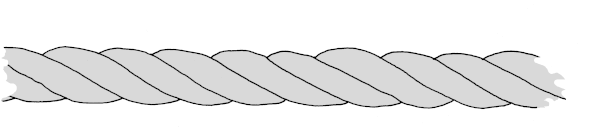
Figure 1: Three-Ply Rope.
| Home |
These are some thoughts about the shape of rope. Not necessarily related to Colonial ropemaking, more about mechanics and geometry.
Figure 1: Three-Ply Rope.
If you start with "S" twist yarns then you have "Z" twist strands, and finish off with an "S" twist rope.
Each level of ropemaking is the same twisting process, just using the end product of the last level as starting materials. Whether you are talking about twisting yarns into strands, or twisting ropes into cables, the geometry is still the same, just the scale has changed.

Figure 2: Path of a Single Strand, "Z" Twist
In Figures 1 and 2, above, the strands are twisted to form a "Z" twist rope.
In Figure 2, the strand goes down to the right on the front of the rope, then back up to the right on the back of the rope, as shown by the dotted lines.
The curling path of a strand explains why a rope gets shorter when it is being twisted. You can easily see the length of a strand by painting a piece of rope, then rolling the rope on a piece of paper, as in Figure 3, below.
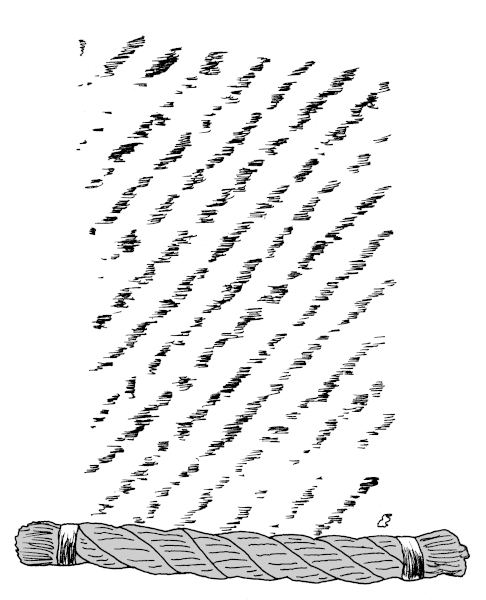
Figure 3: Rolling a Piece of Painted Rope.
The angle between the paint stripes and the rope in Figure 3, or the angle between the axis of a strand and the main axis of the rope in Figure 4, is called the Helix Angle,[630] or sometimes the Angle of Twist[045] and I'm calling it "Theta" (θ) here.
The relationship between the strand length, the rope length, and θ is:
| Eq. 1 | θ = cos-1(L(Rope) / L(Strand)) |
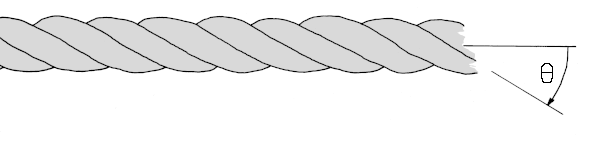
Figure 4: Helix Angle θ.
If a ten inch piece of rope is made up of fourteen inch strands, then theta will be close to 45o.
To make a rope out of three "Z" twist strands, each with a helix angle of θ, you twist them in the equal and opposite direction. That is, an "S" twist with angle θ, or negative θ, as in Figure 5, below.
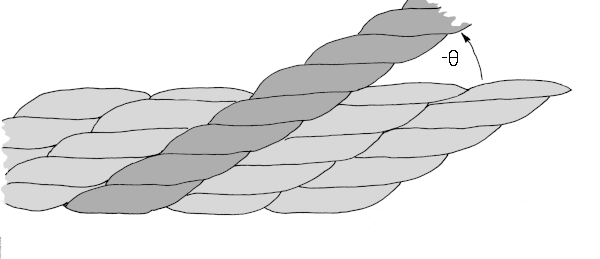
Figure 5: "Z Twist Strand with +θ Helix Angle as Part of "S" Twist Rope with -θ Helix Angle.
The strands are turned -θ to the rope axis which rotates the yarns back parallel to rope axis.
The yarns align with the rope axis on the surface, but what about the yarns on the other side of the strand? Figure 2 shows the yarn passing up the back side of the strand, at the equal and opposite angle. Figure 6 shows the back side yarn is now -2 θ relative to the rope axis. You just don't see it from the outside of the rope.
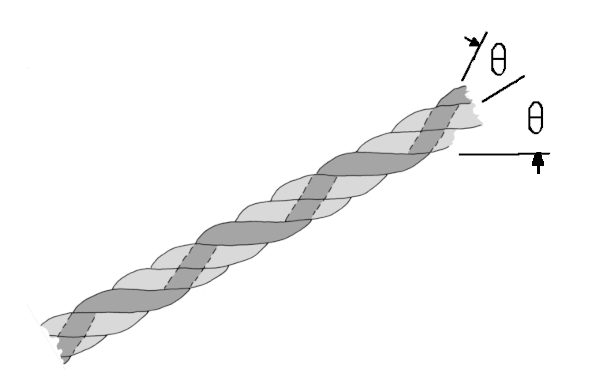
Figure 6: Path of a Single Yarn when Strand is Wrapped at
Opposite Helix Angle.
If you pull two strands of a rope apart, as in Figure 7, you can see the yarns of the back side of the third strand, and they are indeed twice the helix angle of strand.
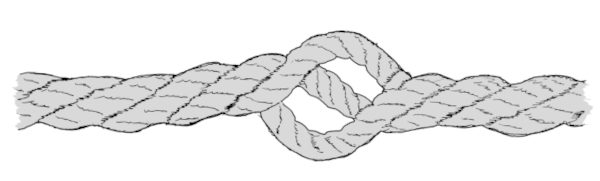
Figure 7: Looking at the Inside of a Rope.
In Figure 8, one yarn of one strand is colored. It shows on the surface of the rope every third yarn on every third strand.

Figure 8: A Single Yarn, Traced Out on the Outside of a Three Ply Rope.
If you carefully remove the other two strands, and turn the remaining two yarns transparent, you can see the entire path of the single colored yarn in Figure 9.

Figure 9: A Single Yarn Path, in an Isolated Strand from a
Three-Ply Rope.
Sometimes the yarn is parallel to the rope axis, sometimes it is almost perpendicular. I have not yet found any research on how the stress is handled by the yarn in those sections where the pull on the ends of the rope is almost 90o to the axis of the yarn.
More research is needed.
Huddart was most active after the American Revolutionary War, at the beginning of the Industrial Revolution. Prior to Huddart, workers pulled yarns off of multiple spools, through a fixed eye, then down the length of the ropewalk, and attached them to a jack, as in Figure 10. This bundle of parallel yarns was then twisted into a strand.
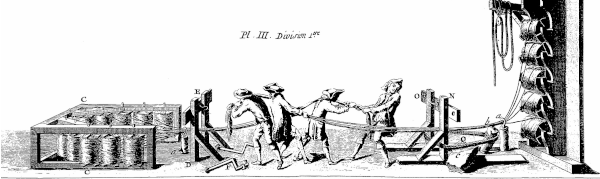
Figure 10: Old Technique for Forming a Strand.
[252]
Huddart's insight was that the yarns on the outside of the strand had to cover a longer distance that the yarns at the center of the strand. But since all the yarns are the same length, the outer yarns were stretched more, bore more strain, and were the first to break.
Figure 11 shows a bundle of yarns in a segment of a strand where the yarns all make one half a revolution around the main axis. The yarn length is related to the number of rotations around the axis of the strand for the length of the strand, and the distance of the yarn from the center of the strand.
| Eq. 2 |
Circular Component = 2 * π * Radius * Number of Revolutions |
| Eq. 3 | Yarn Length2 = Circular Component2 + Length of Strand Segment2 |
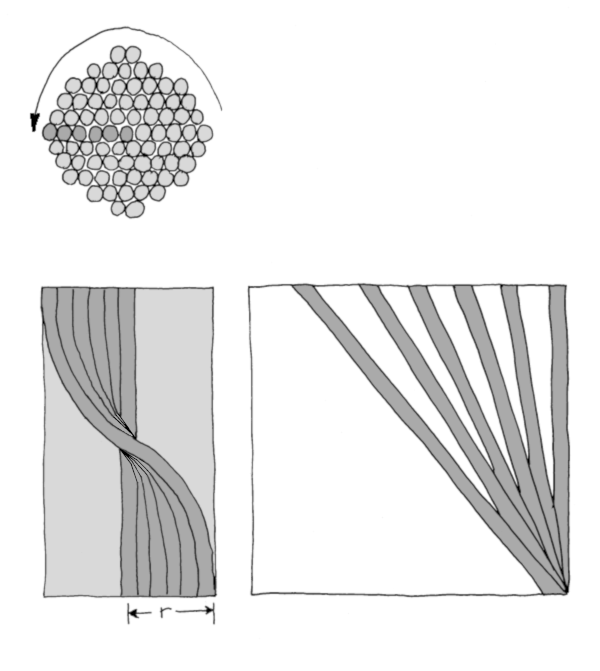
Figure 11: Huddart's Insight: Yarns on the Outside of a Strand are
Stretched More than Yarns at the Center.
Top Left: Cross Section of Strand.
Bottom Left: Profile of Yarns in the Strand.
Bottom Right: The Yarn Path Lengths.
| Radius | Circular Component | Yarn Path Length | Per Cent Strand Length |
| 0 | 0.00 | 20.00 | 100% |
| 1 | 3.14 | 20.24 | 101% |
| 2 | 6.28 | 20.96 | 105% |
| 3 | 9.42 | 22.11 | 111% |
| 4 | 12.57 | 23.62 | 118% |
| 5 | 15.71 | 25.43 | 127% |
In 1793, Captain Huddart designed a machine that twisted the strand as the yarns were pulled off the spools. This allowed the outer yarns to be longer than the inner yarns, and the strain more evenly distributed across the strand.
Huddart's new ropes were stronger and more durable than all previous ropes. Huddart made a fortune.
You can see in Table 1 that the extra Yarn Path Length is not a big deal for the first dozen or so yarns. Even today, people don't bother to twist the yarns while forming the strands, if the strands they are making have fairly small diameters.
The following videos show people making small diameter rope with pre-Huddart strands:
| England | Wyedean - Making Royal Horse Artillery Horse Leads Using a Rope Walk |
| Netherlands | A lost Craft - Traditional rope making |
But as the strands get bigger, and the anchor cable strands for a sailing ship could be many inches wide, you need post-Huddart strands:
| Norway | Making a four strand rope of tarred hemp |
| Sweden | The Rope Walk - Traditional Rope Making for a Swedish East India Ship. |
 |
 |
 |
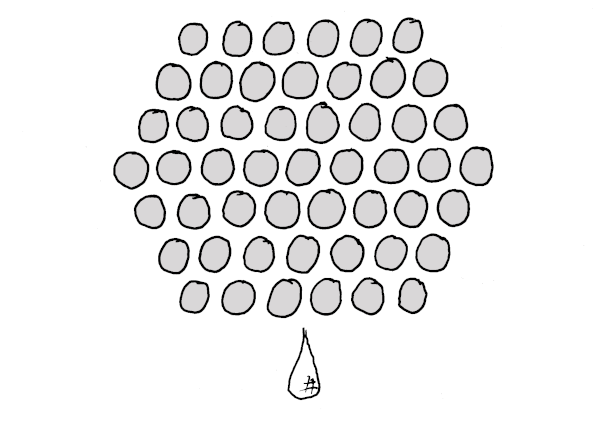 |
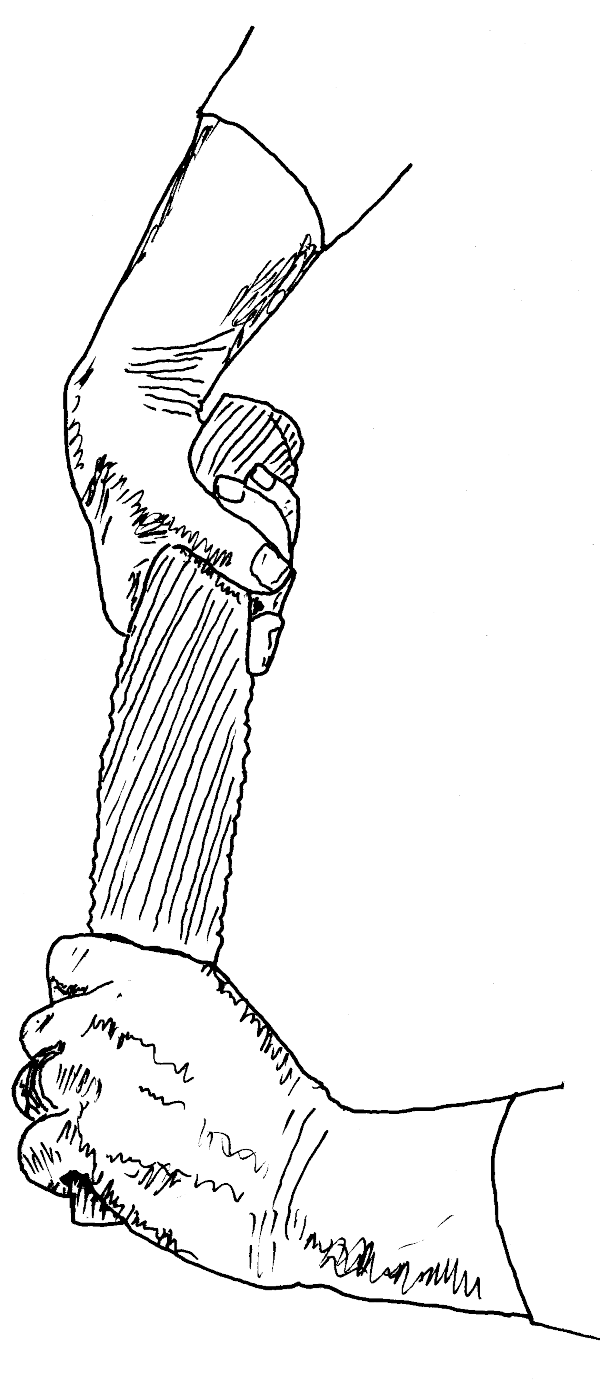
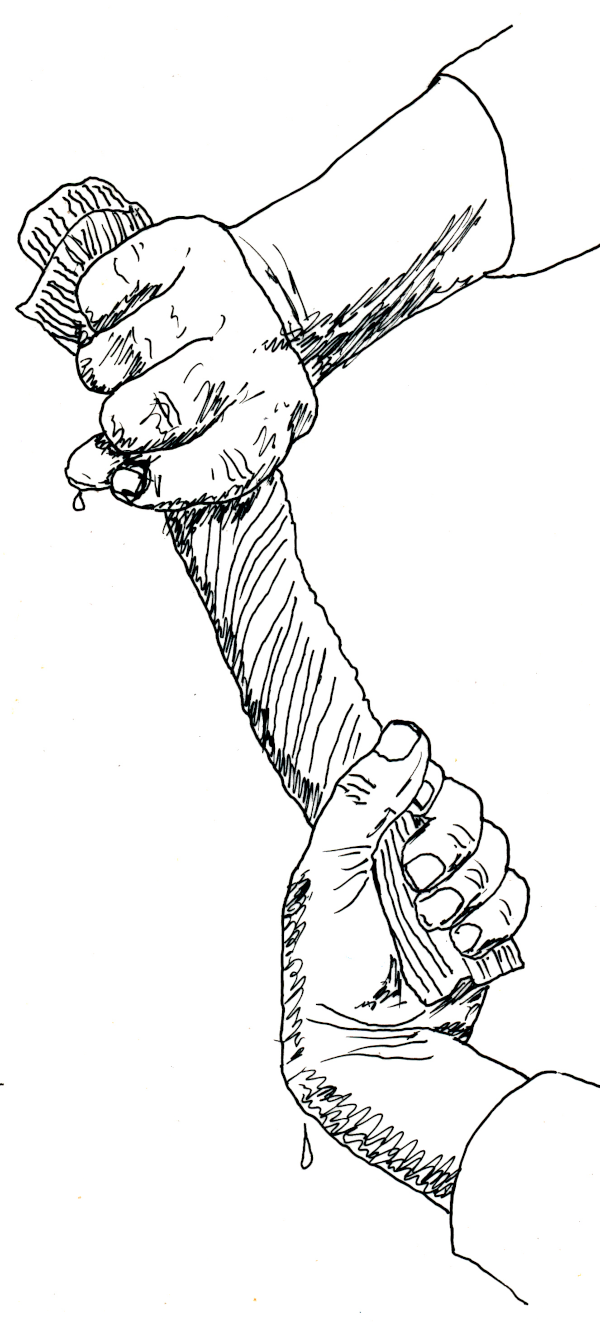
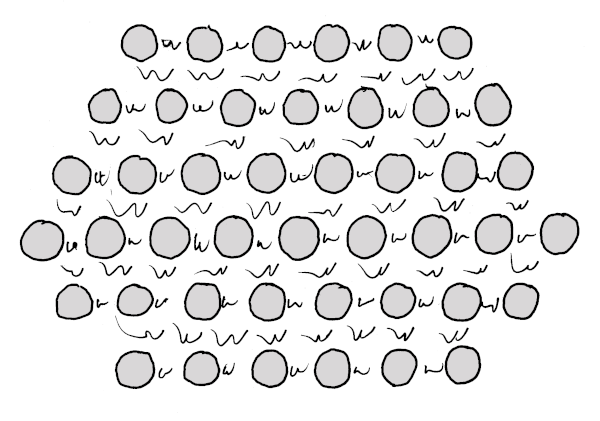
As you twist the washcloth, the cloth doesn't stretch, much. Your hands stay the same distance apart, mostly. What changes is the radius of the gathered washcloth.
Combining and rearranging Equations 3 and 4, above:
| Eq. 5 | Radius = (Yarn Length2 - Length of Strand2)1/2 / (2 * π * Number of Revolutions) |
The Yarn Length is the width of the unscrunched washcloth. The Length of Strand is the distance between your hands. Those two numbers don't change, much. "2" and π are constants, they don't change at all. So the more you twist, the more the Number of Revolutions goes up. And the more the Number of Revolution goes up, the more the Radius of the gathered washcloth goes down, in a direct inverse proportion.
The volume of a cylinder is related to the square of the radius:
| Eq. 6 | Volume = π * Radius2 * Length |
Water doesn't compress, so as you twist the washcloth, the radius decreases, and the volume also decreases, and the water has nowhere to go but out. That's how wringing a washcloth works.
Back to Captain Huddart, the tightly packed yarns in a strand of rope can't compress like the loose weave of a washcloth. As you twist the strand, the length of the strand will decrease, up to a certain point. After that, the only remaining variable is the yarn length, which also has a limit. And then the yarns start to fail.
| Colophon | Contacts |